
Loading...
Loading...
Today’s 50- and 60-year-olds decline outdated narratives about ageing and choose to live with vitality, purpose, and style.
According to a study by the WHO, seniors in age-supportive environments reported higher physical health scores and better mental resilience. With 20 percent of India projected to turn 60 by 2050, it’s time we invested in design empathy
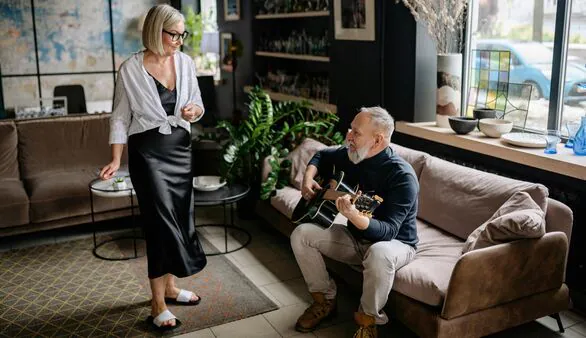
In the quiet interplay between light, space, and form lies a powerful force—design. When done with intention, design becomes more than aesthetics; it becomes a silent enabler of dignity, comfort, and autonomy, especially for the elderly.
Across the world, we are witnessing a redefinition of what it means to age. Today’s 50- and 60-year-olds don’t see themselves as “old.” They reject outdated narratives of decline and dependency, choosing instead to live with vitality, purpose, and style. This active ageing population brings discerning tastes and a hunger for good design, demanding environments that reflect their identities, not just their years. And with growing demographic heft and buying power, they are reshaping the blueprint for senior living as we know it. As someone who has had the privilege of engaging deeply with seniors, both in India and around the world, I have come to understand that dignity in ageing is not an abstract ideal. It is a tangible, living reality, shaped by environments that respect both the limitations and the latent strength of age.
The question, then, is no longer whether to design for seniors, but how to design—thoughtfully, inclusively, and aspirationally.
Across the globe, forward-thinking nations are investing in what I call design empathy—the practice of anticipating the needs of older adults through thoughtful architecture and interiors. From Tokyo to Copenhagen, global examples offer compelling inspiration. In Japan, compact yet intuitively laid-out apartments support ageing in place. The private units are smaller, and the shared spaces are larger. The residents share kitchens, bathrooms, theatres, and gardens – instead of just narrow hallways. It’s this type of design solution – a blending of the public and private, homage towards tradition but openness to modern ways of living – that offers tremendous relevance for India. Scandinavia continues to integrate intergenerational and age-inclusive design in public infrastructure, proving that connectivity and wellness are not luxuries but necessities.
With India’s strong cultural emphasis on community and interdependence, as well as increasingly urban lifestyles, such models can offer both emotional enrichment and spatial efficiency. In a country where family structures are evolving and social dynamics are shifting, creating shared environments that nurture connection while preserving privacy offers a thoughtful and timely way to reimagine senior living in Indian cities. Increasingly, thoughtfully designed shared spaces, such as communal dining areas, meditation rooms, and landscaped courtyards, with ample seating areas to rest and socialise and are being integrated into residential formats for seniors, encouraging organic interaction and collective well-being while still respecting personal space. These spatial choices reflect a deeper design philosophy: one that recognises the human need for both connection and convenience, especially in the later stages of life.
One of my most enduring learnings has been that older adults do not wish to be reminded of their vulnerabilities, they wish to be celebrated for their wisdom, experiences, and continued contributions. Design, when done right, makes limitations invisible and enables freedom.
According to NITI Aayog, 24% of seniors in India have limitations in activities of daily living, 58% face difficulty with stooping, climbing, or kneeling, and 43% rely on aids or supportive devices. This data spotlights the strong requirement for environments that support mobility and independence in later life. Thoughtful interventions to make spaces more senior-friendly, such as zero-step entryways, anti-skid flooring to minimise risks of falls, and rounded corners with smooth edges, silently but strongly enable seniors to move around more safely and confidently.
Seniors thrive when their physical, mental, and emotional needs are equally nurtured. Ageing brings many changes – memory lapses, reduced sensory capacity, reduced mobility, and mood changes. In those with cognitive decline, warm lighting has been shown to reduce agitation; non-reflective, soft flooring reduces sensory overload and falls. Even colour choices and spatial familiarity influence orientation and comfort.
We have found that when design respects lived experience, it enhances well-being. When design works past isolation, it invites interaction and builds community. And when it offers choice and flexibility, it affirms a person’s agency. These aren’t just design preferences—they’re lifelines to a dignified and fulfilled life. Data underscores this too. A World Health Organisation study showed that seniors in age-supportive environments report higher physical health scores, better mental resilience, and stronger social ties.
Design is not just about creating beautiful spaces, it’s about helping people thrive. Design is not merely about form or function; it is a quiet expression of care. These are spaces that are not only safe and functional but also soulful, imbued with warmth, beauty, and belonging. As India witnesses a demographic shift, with nearly 20% of our population projected to be over 60 by 2050, it is imperative that we reimagine how we build and furnish with care. Ageing is as much a design imperative as it is a healthcare, planning and policy imperative. I believe deeply in the power of design to humanise. In building for dignity, not just independence. And creating a new narrative around ageing that is active, empowered and joyful.
Tara Singh Vachani is executive chairperson of Antara Senior Care and vice-chairperson of Max India Limited, New Delhi.