
Loading...
Loading...
 BACK
BACK2026-07-07
Short Answer: Neuroplasticity is the brain's built-in ability to repair and rewire itself after injury. After a stroke, healthy brain tissue takes over functions that were lost, but only when given the right signals through structured neurological rehabilitation. This rewiring doesn't happen passively; it requires active, repeated, goal-directed effort, and the sooner it starts, the more the brain can recover.
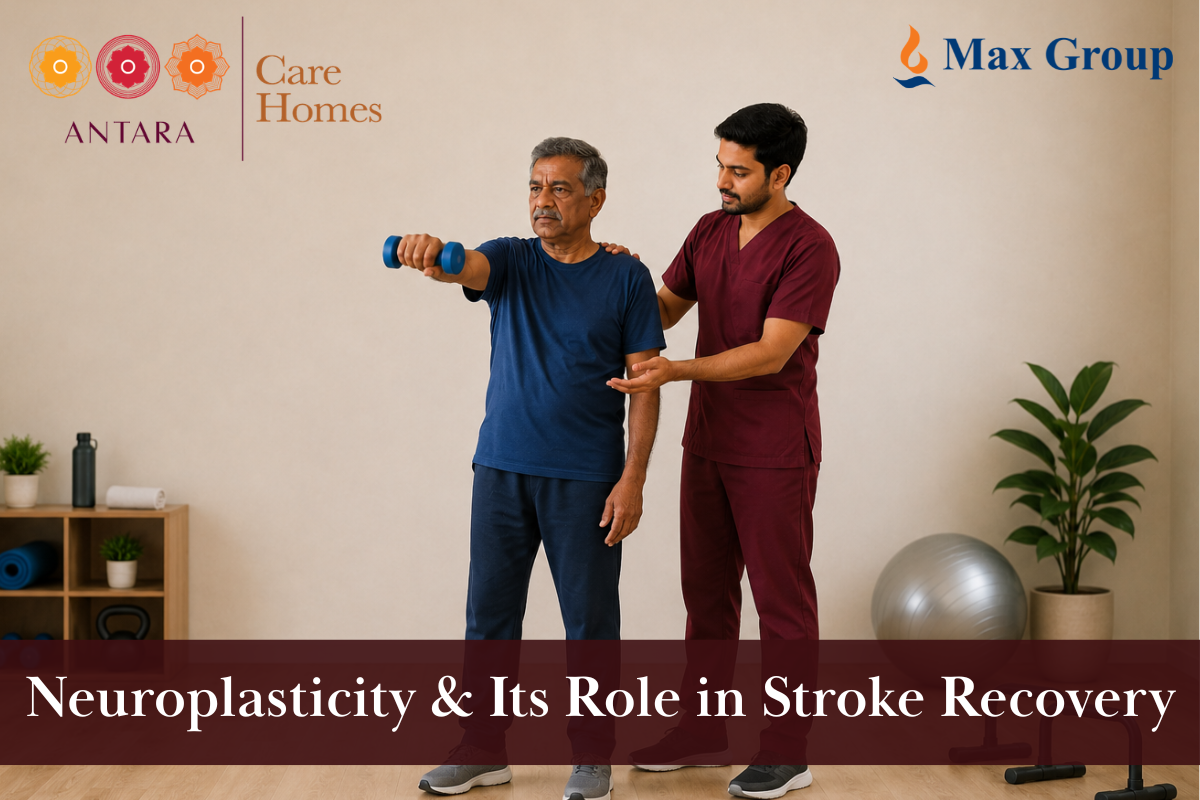
Here is something most stroke survivors and their families never get told clearly: the brain has a genuine ability to recover, and that recovery is not accidental.
It is driven by neuroplasticity, the science of how the brain physically changes itself based on what it is asked to do. Understanding this one concept shifts everything about how stroke recovery should be managed, from what therapies matter, to why timing is critical, to what actually causes some people to recover.
Think of the brain as a city powered by a network of roads. A stroke is a sudden road closure, blood stops flowing, oxygen stops arriving, and the area it was serving goes dark. Brain cells in that area start dying within minutes, which is why getting treatment fast matters so much.
But the damage does not stop at the core of the blockage. There is a surrounding zone of injured tissue, medically called the ischemic penumbra, where cells are damaged but not yet dead. This zone is treatable if blood flow is restored quickly enough, and it also holds real potential for recovery even after the immediate crisis passes.
What makes stroke recovery complicated is that the brain does not have a simple backup switch. The regions responsible for movement, language, memory, and coordination are specific.
The brain changes physically based on what it repeatedly does. This is neuroplasticity in its simplest form, and it operates through several processes happening simultaneously after a stroke.
When a neural pathway is used over and over, the connection between those neurons gets stronger. Think of it like a path through tall grass: the more it is walked, the clearer it becomes. The opposite is also true, pathways that are never activated weaken and fade.
After stroke damage, neighbouring brain regions begin to take on functions previously handled by the injured area. This is called cortical remapping, and it is the central mechanism behind most functional recovery. The degree to which it happens depends significantly on how actively and consistently the patient engages in rehabilitation.
Recovery after a stroke is not linear and it is not automatic. Neuroplasticity gives the brain the capacity to rebuild, but that capacity needs to be actively directed.
In the weeks immediately following a stroke, the brain is in a heightened state of adaptability. Neurons are more responsive, connections form more readily, and the brain is essentially more open to learning than it normally is. This is the period when consistent, intensive neurological rehabilitation produces its strongest results.
There is also a side of neuroplasticity that is less discussed but equally important. The brain does not distinguish between good recovery and bad recovery. If a patient starts favouring their unaffected side, avoiding use of the weaker arm, or developing incorrect movement patterns out of habit, the brain begins hardwiring those compensatory patterns instead of the actual functions. This is called maladaptive plasticity, and reversing it later is significantly harder than preventing it in the first place.
Timing is not everything in stroke recovery, but it is close.
The brain's heightened plasticity window is real and it is finite. In the weeks right after a stroke, the brain is far more responsive to rehabilitation than it will be six months later. Patients who access structured neurological rehabilitation early consistently achieve better functional outcomes than those who start later, and the gap between the two groups is not small.
What delayed rehabilitation allows to happen is also significant. Maladaptive patterns set in. Muscles weaken from disuse. Compensatory habits become the brain's new normal. None of these are easy to reverse.
Each therapy used in stroke rehabilitation is effective precisely because it activates and directs neuroplasticity in a targeted way.
Physiotherapy rebuilds motor pathways through repetitive movement, targeting walking, balance, coordination, and strength.
Occupational therapy focuses on real-world tasks like eating, bathing, and writing, training the brain to relearn the functions daily life requires.
Speech therapy addresses both communication and swallowing difficulties common after stroke disease.
Constraint-Induced Movement Therapy forces the use of the affected limb by restricting the stronger one, preventing the brain from wiring in avoidance.
Cognitive rehabilitation uses structured mental exercises to rebuild attention, memory, and problem-solving capacity.
You should choose a stroke rehabilitation carefully that must provide all these therapies such as Antara care homes. All these therapies help patients recover faster & smoother.
Stroke recovery is not about waiting for the brain to heal on its own. It is about giving the brain the right inputs, consistently and early, so it builds the recovery you are aiming for.
Neuroplasticity makes this possible. Neurological rehabilitation in chennai makes it happen. For anyone navigating stroke recovery, whether for themselves or someone they love, the single most important step is starting structured neurological care in Bangalore or wherever they are located as soon as medically appropriate.
The brain can be rebuilt. But it needs the right direction to do it.
1. Can the brain fully recover from a stroke through neuroplasticity?
Full recovery depends on the severity of the stroke and how early rehabilitation begins. Many patients regain significant function.
2. How long does the brain stay in its high-plasticity window after a stroke?
The most responsive period is generally the first three to six months. After that, plasticity continues but at a slower rate.
3. Is neuroplasticity-based rehabilitation suitable for elderly stroke patients?
Yes. The brain retains its capacity to rewire at any age. Older adults may progress more slowly, but consistent neurological rehabilitation produces meaningful gains in seniors just as it does in younger patients.
4. What is the biggest mistake families make during stroke recovery?
Waiting too long to start rehabilitation or stopping it too soon because progress slows. Both allow maladaptive patterns to form and reduce the amount of recovery that is ultimately possible.
5. What does neurological care in Bangalore typically include for stroke patients?
A comprehensive neuro care program in Bangalore typically covers physiotherapy, occupational therapy, speech therapy, cognitive rehabilitation, and psychological support.
Best Stroke Rehabilitation Centre in Bangalore: Recovery, & ...
Best Stroke Rehabilitation Centre in Chennai: Recovery, & Co...

How to Safely Get Out of Bed After Open Heart Surgery

Best Physiotherapy Exercises for Shoulder Pain at Home

Best Physiotherapy at Home Services in Bangalore

Please fill in the form and submit the details to request an appointment.