
Loading...
Loading...
 BACK
BACK2026-07-18
Families looking for a neurological rehabilitation for a loved one recovering from stroke, spinal injury, or another neuro condition often run into this question: the hospital mentioned robotic rehabilitation, the physiotherapist is recommending conventional therapy, and nobody has explained clearly what the difference actually is or which one makes more sense.
Both have real clinical value. Neither is universally better. And in the best rehabilitation programs, they are not competing with each other at all.
This guide breaks down what each approach involves, where they differ, when robotic gait rehabilitation becomes relevant, and why the most effective neurological rehabilitation programs use both together.
Conventional neuro physiotherapy for neurological conditions has been the backbone of neuro rehabilitation for decades, and for good reason. It works.
In stroke rehabilitation and other neuro conditions, conventional physiotherapy targets the motor system through hands-on, therapist-guided movement. The physiotherapist assesses where the patient is, what movements are possible, and what the nervous system needs to be retrained toward. From that assessment, a progressive program of exercises, stretches, weight-bearing activities, balance training, and gait work is built and adapted session by session.
What makes conventional physiotherapy particularly powerful in neurological rehabilitation is its responsiveness. A skilled neuro physiotherapist reads the patient in real time. They notice when a movement pattern is compensatory rather than correct. Conventional physiotherapy also reaches beyond the physical. The therapeutic relationship between a patient and their physiotherapist is clinically significant.
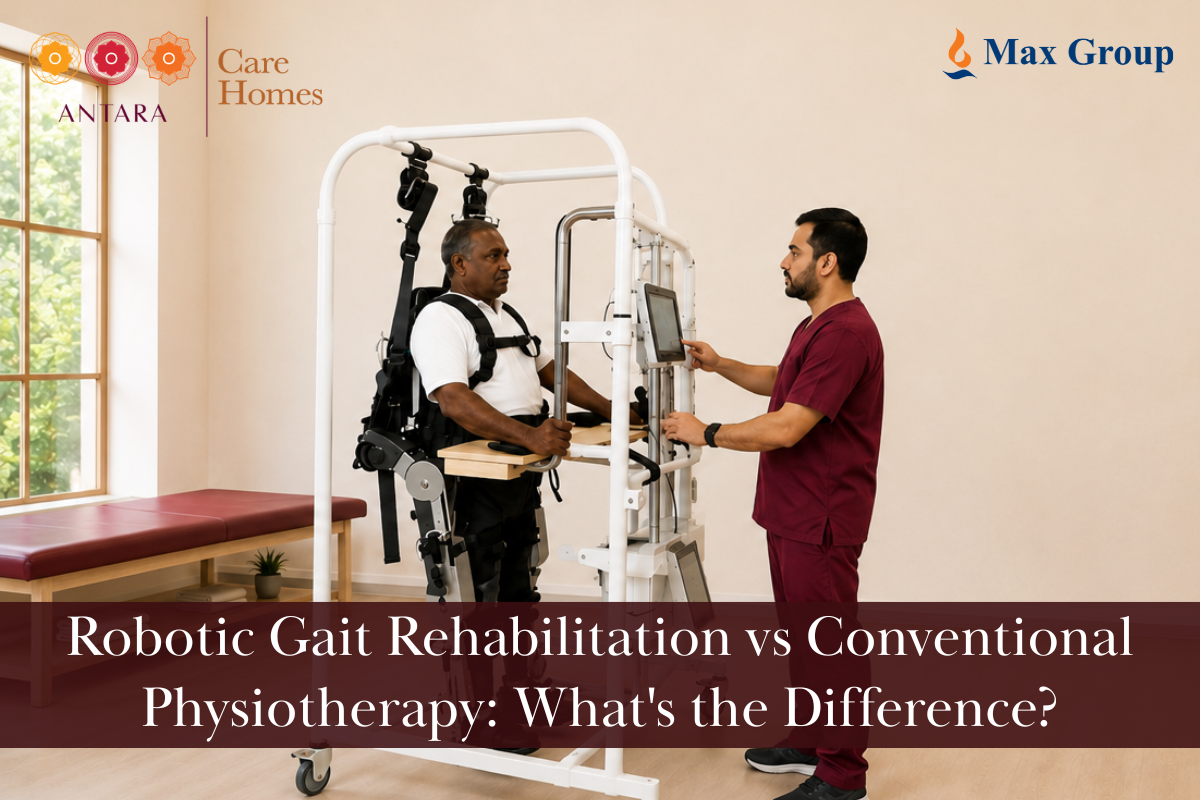
Robotic gait rehabilitation uses technology to deliver high-volume, precisely controlled movement therapy to patients who cannot yet achieve those movements independently or with conventional support alone.
Robotic systems used in neuro rehabilitation typically fall into two categories. Exoskeleton-based devices are wearable robotic frameworks that support and move the patient's limbs through programmed gait patterns, allowing someone with significant motor impairment to experience the sensation and mechanics of walking before they have the independent strength to do so. End-effector devices work differently, controlling the feet through footplates that simulate walking motion while the patient is supported in a harness, without the full limb encasing of an exoskeleton.
Both types share a core principle: they allow the brain to receive the correct sensory and motor input of normal gait, repeatedly, at a volume that manual therapy cannot match.
Robotic rehabilitation also provides something conventional therapy cannot: precise, objective data.
The distinction between robotic gait rehabilitation and conventional physiotherapy is not simply old technology versus new technology. They address different parts of the same problem.
Conventional physiotherapy is adaptive, relational, and comprehensive. It addresses the whole patient, not just the gait pattern. It trains functional movement in varied, real-world contexts.
Robotic rehabilitation delivers repetition at a scale that human-led therapy cannot match, particularly in the early stages of neurological recovery when voluntary movement is minimal or absent.
The key difference is this: robotic rehabilitation does what conventional physiotherapy cannot do at scale in severe impairment; conventional physiotherapy does what robotic systems cannot do in terms of clinical judgment, adaptability, and real-world function. One without the other is an incomplete approach.
Robotic gait rehabilitation is not appropriate for every patient or every stage of recovery. There are specific clinical scenarios where it adds value that conventional physiotherapy alone cannot provide.
It is most relevant in the early to middle phases of stroke rehabilitation when the patient has significant lower limb weakness or complete hemiplegia, making independent gait practice impossible and manual-assist walking difficult to sustain at the repetition volumes that neuroplasticity requires. It is also used in spinal cord injury rehabilitation where partial motor function exists and the goal is to reinforce residual neural pathways through high-volume correct movement input.
Robotic gait training in the early phases of stroke rehabilitation establishes the correct neural template for walking. It gives the brain the high-volume correct-pattern input that drives neuroplasticity before voluntary control is sufficient for conventional walking practice.
Think of it this way: robotic rehabilitation writes the code; conventional physiotherapy teaches the brain to run it in real conditions. A patient who only receives robotic training may walk well on the device and struggle on uneven ground.
At Antara Care Homes, stroke rehabilitation and neuro rehabilitation are delivered through a multidisciplinary model that integrates physiotherapy for neuro conditions, gait training, occupational therapy, speech therapy, and cognitive rehabilitation into a coordinated individual plan.
The goal at Antara is not to offer the most advanced technology. It is to deliver the most effective combination of approaches for each individual patient, at the right time, with the clinical expertise to know the difference.
The question is not which is better, robotic gait rehabilitation or conventional physiotherapy. The more useful question is what each does well, and when.
Conventional physiotherapy brings clinical judgment, adaptability, and the therapeutic relationship that drives motivation and real-world function. Robotic rehabilitation brings precision, data, and the capacity for high-volume correct-pattern movement in severe impairment.
For families choosing a rehabilitation facility, the right question is not whether they have a robotic device. It is whether they know how to use it as part of a clinical plan built around the patient in front of them.
1. Is robotic gait rehabilitation better than conventional physiotherapy for stroke recovery?
Neither is categorically better. Robotic rehabilitation delivers high-volume, precise gait training that is particularly valuable in severe impairment when conventional therapy alone cannot achieve sufficient repetition.
2. How does robotic rehabilitation support neuroplasticity?
Neuroplasticity responds to repeated, correct-pattern movement input. Robotic systems allow the brain to experience the correct sensory and motor signals of normal gait at a volume that manual therapy cannot match.
3. Who is a good candidate for robotic gait rehabilitation?
Patients with significant lower limb weakness or hemiplegia following stroke or spinal cord injury are the primary candidates, particularly in the early to middle phases of rehabilitation.
4. How long does robotic gait training take to show results?
Early neuroplastic changes can occur within weeks of consistent robotic gait training, though functional walking improvements in real-world settings typically emerge over one to three months of combined robotic and conventional rehabilitation.
5. Does Antara Care Homes offer robotic rehabilitation for neuro conditions?
Antara Care Homes provides advanced neurological rehabilitation including structured gait training as part of a comprehensive, individualised rehabilitation program.
Best Stroke Rehabilitation Centre in Bangalore: Recovery, & ...
Best Stroke Rehabilitation Centre in Chennai: Recovery, & Co...

How to Safely Get Out of Bed After Open Heart Surgery

Best Physiotherapy Exercises for Shoulder Pain at Home

Best Physiotherapy at Home Services in Bangalore

Please fill in the form and submit the details to request an appointment.