Loading...
Loading...
 BACK
BACK2026-05-08
Dr. Vivekanandhan. B
My neighbor's father had a paralysis attack two years back. Stroke. The left side was completely paralysed. He came home from the hospital after 12 days and everyone in the family was relieved that he was alive, relieved the worst was over.
But It wasn't over, it was just starting.
Within three months, his daughter had to quit her job. The family had burned through their savings. Her husband was sleeping on the living room couch because the bedroom had been converted into a proper hospital ward. And nobody at the hospital or the discharge nurse had told them this was the next step.
That's what this article is about. Not just the medical stuff you'll find on every hospital website but the real cost. The kind that does not show up until you're already deep in it.
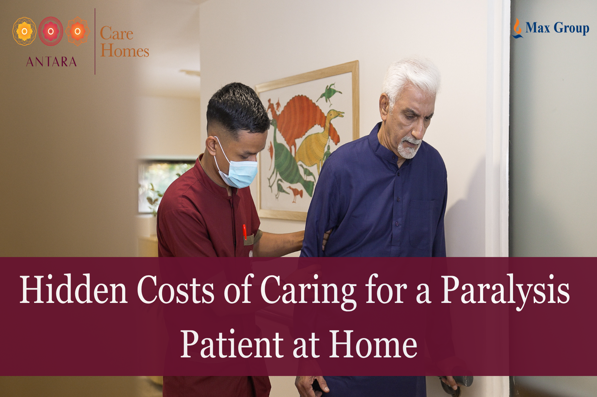
Paralysis happens when the brain can no longer send signals to the muscles, usually because of damage to the nervous system from a stroke, a spinal cord injury, or something like a traumatic brain injury from an accident. The muscles don't get the message. So they stop moving.
It can be one limb, one side of the body, the lower half. Or in severe cases, everything from the neck down.
In India, strokes contribute around 1.8 million medical cases a year. A lot out of those people survive but with partial or full paralysis. And most of them end up being cared for at home because that's just how it works in our country. Families have to help, that's the culture and that's also the expectation.
Nobody questions it. They just do it. And quietly, over the months, it takes a toll that nobody prepared these families for.
The Nursing Cost (Which Never Stops)
If you hire a professional caregiver and most families need at least part-time professional when it comes to paralysis home care, you're looking at ₹1,000 to ₹3,500 per day for home nursing. That's somewhere between ₹30,000 and over ₹1,00,000 every single month. Just for one personal care attendant helping with basic needs of the patient like Bathing, Repositioning (you have to turn a bedridden patient every two to three hours, or they develop bedsores with painful, infected wounds that can become life-threatening), Feedings, Medicine, Catheter management, Bowel care etc.
Most families in India cannot afford a full-time nurse care. So they handle it themselves. Which means somebody, usually a daughter, a daughter-in-law, a wife or a son becomes the full-time caregiver. He/She doesn't get paid or any days off or as it is in our country no credit either in most cases because you are simply taking care of family and that is your duty by default.
This not only takes toll on mental health of the caregiver, but patient also struggles as paralysis pateint actually needs paralysis rehabilitation.
Physiotherapy (The Thing You Cannot Skip)
This is where most families make a severe mistake. They think physio is optional where it is not.
After a paralysis attack, the muscles need movement, passively at first, then actively as the patient recovers. Without consistent physiotherapy, joints get sore. Muscle mass is decreasing by the day. Spasticity sets in and that's painful, uncontrollable stiffening that makes the limbs rigid. Once that happens, it becomes much harder to reverse and recover.
Private physio sessions in Indian tier 1 and tier 2 cities run ₹1000 to ₹1,500 per visit. If the patient needs daily sessions in the early months which most of them do, that's ₹15,000 to ₹45,000 per month, on top of everything else.
There's something called the golden period, roughly the first 90 days after a paralysis attack. This is when the brain can recover the most and is most capable of rewiring itself. Paralysis treatment during this window gives the highest chance of meaningful recovery. Families who cannot afford consistent sessions during this time suffer the most and sadly see permanent losses in function that could have been recovered and that's the brutal truth of it.
Equipment — Bought Piece by Piece, Always Unexpectedly
Nobody comes home from the hospital with a list of everything they'll need. You find out one by one with time.
First is a wheelchair. A basic one starts around ₹5,000, but a good one that actually supports the patient's body properly can cost anywhere from ₹20,000 to ₹60,000. Then it's the hospital bed because a regular bed is too low or too soft. Then a special mattress as per the patient's needs. A commode chair and Grab bars in the bathroom. A ramp if there are steps at the entrance. A suction machine if the patient has trouble swallowing.
Each one feels like it's the last thing you'll need to buy but Its never the last for some patients who need more care. This list might even be bigger and the cost multiplies accordingly.
Medicines Every Month
Paralysis treatment isn't just physio. Most patients require long-term medications, blood pressure drugs, blood thinners, drugs for spasticity, bladder medications, sometimes antidepressants and sometimes anti-seizure medicines. Every one of them have a monthly cost.
Add it up and you're often looking at ₹5,000 to ₹15,000 per month in prescriptions alone, sometimes more, depending on what the patient needs.
The Stuff Nobody Counts
Home modifications done for the patient also cost money. Widening a doorway for a wheelchair. Installing a hospital-grade shower setup. Buying a hospital-style table that swings over the bed or even a simple bed table.
Travel to physiotherapy centres adds up if the physio therapist cannot do home visits or if one can't afford them. Petrol, auto fares, the time lost, the help needed to get the patient in and out of a vehicle.
Doctor follow-ups. Blood tests. Occasional hospital readmissions when something goes wrong from a simple UTI or a bedsore that got infected or worse, a fall.
Total it all and most families are spending somewhere between ₹50,000 and ₹1,50,000 per month on home-based paralysis care. In a country where many middle-class households earn less than that, this is not sustainable for long.
The patient is grieving. That sounds strange, but it's very accurate. A person who was independent, drove themselves, fed themselves, went to work, made decisions is now dependent on others for the most basic functions. That loss of dignity is deeply hurtful, they may not show it physically but it takes a huge toll on the patient's mental health. Depression after a paralysis attack is very common. So is anxiety, anger, and withdrawal.
Traumatic brain injury survivors face this, sometimes their personality changes, their memory slips, they are emotionally affected. The family is not just caring for a physically different person. Sometimes they're caring for someone who seems emotionally different too.
And the caregiver? They're exhausted in a way that sleep simply can’t fix. They feel guilty for feeling resentful. They feel resentful for feeling guilty. They stop seeing friends because there's no one to sit with the patient and they simply don’t have any personal space or time left. They stop going to the doctor themselves because there's just no time. Caregiver burnout is not a personal failing, This is what happens when one person carries too much for too long with no relief.
Get a proper rehabilitation assessment early. A physiatrist or a doctor who specializes in rehabilitation medicine should see the patient within the first few weeks and map out a realistic recovery plan. Not just "do physio." An actual plan with goals, timelines, and milestones is usually helpful.
Look at residential rehab seriously. A lot of families assume home is always better. Sometimes it isn't. The best paralysis treatment in India is increasingly available at specialized neuro-rehab centres in tier-2 cities, often at a cost that's actually similar to, or less than, what families spend together home nursing plus physio plus equipment. And during that critical 90-day golden period, intensive structured care in a paralysis rehab facility such as Antara Care Homes often gives better outcomes than the same care given at home.
Sort out insurance before the bills pile up. Paralysis typically falls under critical illness coverage. If the family has a critical illness policy, a lump sum claim is possible. Standard health insurance may cover hospitalization and documented rehab expenses. Talk to the insurer early and not six months in when you're already deep into this.
Don't skip the mental health piece. For the patient and for the caregiver. A psychologist who works with neurological patients isn't a luxury. It's as much part of paralysis treatment as physiotherapy is.
The family that's caring for a paralysis patient at home is doing something very hard, what most people cannot imagine doing in their life. The costs are real, financial, physical, emotional, and most of them come attached to paralysis.
Knowing this in advance doesn't make it easy. But it makes it a little manageable. It means you plan first before reacting. You ask questions before the money runs out. You set up systems before the caregiver collapses.
Paralysis treatment isn't just about the patient getting better. It's about the whole family surviving this together, with their finances and their health and their relationships still intact.
That's the goal. And it's achievable if you go in with your eyes open.

Please fill in the form and submit the details to request an appointment.