Loading...
Loading...
 BACK
BACK2026-08-14
Dr. Vivekanandhan. B
Summary
A spinal cord injury changes life quickly, but recovery is rarely as fixed as it feels in the first weeks. Rehabilitation works in stages, beginning in the hospital bed with positioning and breathing work, moving through strength and balance training, and ending with the practical skills of independent living. Physiotherapy sits at the centre of that process, supported by occupational therapy, nursing care, and newer tools such as robotic gait training. Progress is slow, uneven, and often greater than families expect at the start.
The spinal cord is the communication line between the brain and the rest of the body. When it is damaged, messages travelling in both directions are interrupted. Movement signals do not reach the muscles below the injury, and sensory signals do not travel back up.
Injuries are described in two ways that matter for recovery.
Level. This refers to the lowest segment of the cord still working normally. Cervical injuries affect the arms, trunk, and legs, and are described as tetraplegia. Thoracic, lumbar, and sacral injuries affect the trunk and legs and are described as paraplegia. The higher the level, the wider the effect.
Completeness. A complete injury means no motor or sensory function remains below the level of injury. An incomplete injury means some signals still cross the damaged area, and this is where the greatest potential for functional recovery usually sits. Clinicians grade this using the ASIA scale, from A through E.
Causes vary by region and age group. Road accidents, falls from height, diving injuries, and sports account for most traumatic cases, and falls are increasingly common among older adults. Non traumatic causes include tumours, infections such as tuberculosis of the spine, inflammatory conditions, and vascular events.
The effects extend well beyond walking. Bladder and bowel control, blood pressure regulation, temperature control, sexual function, breathing capacity in higher injuries, spasticity, and neuropathic pain all fall within the picture. Good rehabilitation addresses all of them, not only the visible ones.
Rehabilitation does not repair the cord. What it does is train the body to work as well as possible with what remains, protect against the complications that cause most long term harm, and rebuild independence in daily life. It moves through recognisable stages.
Stage one: the acute phase
This begins within days of injury or surgery, while the person is still medically fragile. The goals here are protective rather than restorative.
Therapists work on chest physiotherapy and breathing exercises, which matter enormously because respiratory complications are a leading cause of death after cervical injury. Limbs are moved through their full range daily to prevent joints stiffening and muscles shortening. Positioning and turning schedules protect the skin from pressure sores, which can undo months of progress if they develop. Where the spine has been surgically stabilised, all of this happens within precautions set by the surgeon.
Patients are gradually brought upright using tilt tables, because blood pressure regulation is often disrupted and the body needs retraining to tolerate sitting.
Stage two: the subacute phase
Once the person is stable, the work becomes active. This is the longest and most demanding stretch, usually running several weeks to several months in an inpatient rehabilitation setting.
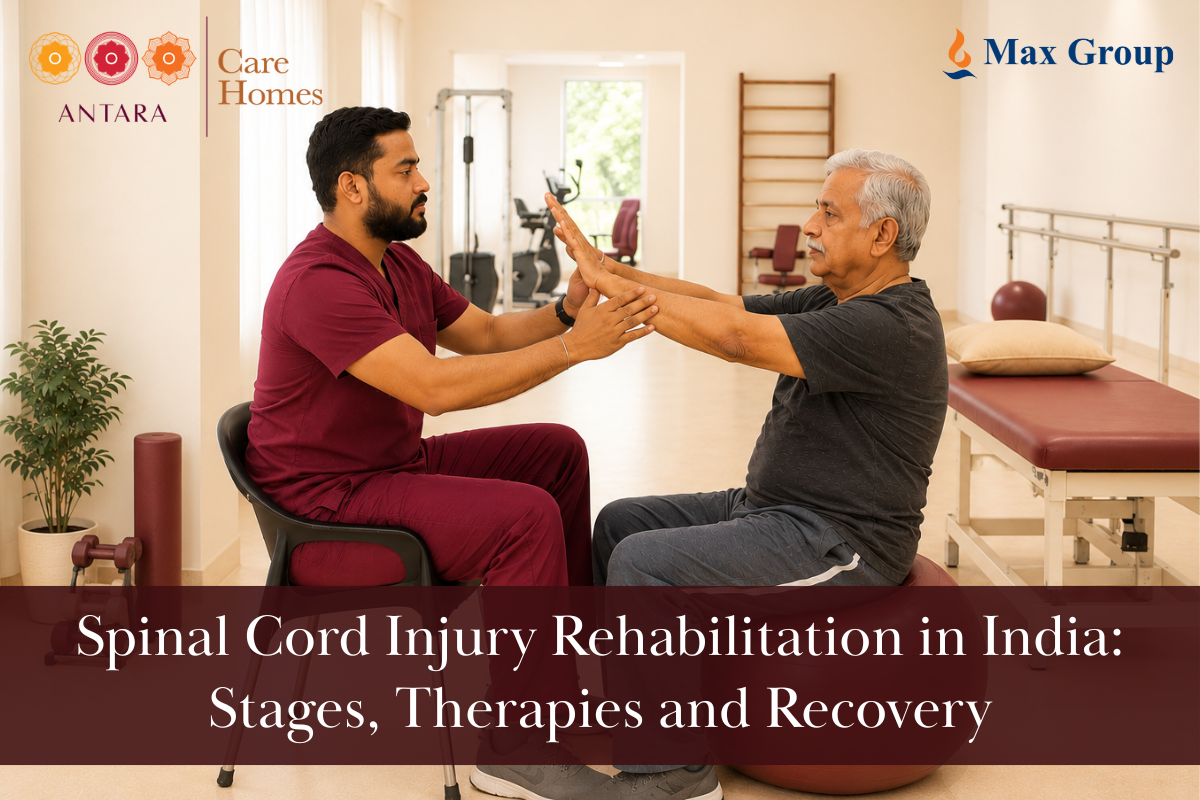
Strengthening focuses first on whatever is preserved. Shoulders, arms, and trunk take on a much larger role, since transfers and wheelchair propulsion depend on them. Where muscle activity exists below the injury, even faintly, it is trained deliberately and repetitively, because repetition drives the neuroplastic changes that underpin recovery.
Sitting balance comes before everything else. A person who can sit unsupported can dress, eat, transfer, and eventually push a wheelchair. Therapists work on trunk control, reaching outside the base of support, and recovering from a wobble without falling.
Transfer training follows: bed to wheelchair, wheelchair to toilet, wheelchair to car. These are taught as precise techniques, not improvised movements, because doing them badly wrecks shoulders over a lifetime of use.
Alongside this, nurses and therapists establish bladder and bowel programmes, manage spasticity through stretching, positioning, splinting and medication, and treat neuropathic pain.
Stage three: functional independence and community reintegration
The final stage shifts attention from the body to the life around it. Occupational therapists work on dressing, bathing, cooking, and writing, often with adapted equipment. Wheelchair skills training covers kerbs, ramps, slopes, and uneven ground. Home assessments identify what needs changing, whether that is a ramp, a wider doorway, a grab rail, or a different bathroom layout.
For people with incomplete injuries, gait training belongs here: parallel bars first, then walkers or crutches, often with orthoses such as ankle foot orthoses or knee ankle foot orthoses.
Psychological support runs through every stage and is too often treated as optional. Depression, grief, and anxiety are common and entirely understandable. Vocational counselling, driving assessment, and peer support groups help people rebuild identity rather than simply function.
Caregiver training belongs here too. Families who are taught safe transfers, skin checks, and bowel routines manage far better at home than those who are handed a discharge summary and sent away.
Robotic rehabilitation has moved from research labs into mainstream centres over the past decade, and several Indian hospitals now offer it.
The main categories are robotic gait trainers, which support the body over a treadmill and guide the legs through a walking pattern, exoskeletons that a person wears and walks in over ground, and robotic arm devices for upper limb training after cervical injury. Functional electrical stimulation is often paired with these systems to activate muscles in time with the movement.
Robots deliver far more repetitions than a therapist can manually, with consistent quality, and they let a person experience the sensation and rhythm of walking early, which appears to help the nervous system reorganise. Body weight support also allows upright work long before someone could manage it independently. Secondary benefits include better bone density, bowel motility, and cardiovascular conditioning from time spent upright.
The honest limits matter as well. Robotic training is not available everywhere but at antara care homes bangalore It works best for incomplete injuries, faster recovery. Current evidence suggests it is a valuable addition to conventional physiotherapy rather than a replacement for it, and outcomes still depend heavily on the skill of the team's programming and supervising the sessions.
Post Operative rehabilitation is a long project, not a course of treatment. The trajectory usually runs from protective care, through hard physical retraining, to the practical business of living independently again. Most neurological recovery occurs in the first six to twelve months, but functional improvement, meaning what a person can actually do, continues for years with consistent work.
Start rehabilitation as early as medically possible, choose a centre with a genuine multidisciplinary team rather than physiotherapy alone, and keep the home programme going after discharge. That last part is where a great deal of long term outcome is decided.
How long does rehabilitation take?
Inpatient programmes commonly run from six weeks to six months depending on injury level and completeness. Outpatient and home based therapy continues well beyond that.
Will walking return?
It depends on completeness and level. Many people with incomplete injuries regain some walking ability, often with orthoses or aids. Complete injuries carry a much lower likelihood, and rehabilitation then focuses on independence through wheelchair mobility.
When should rehabilitation start?
As soon as the person is medically stable, often within the first week. Early intervention reduces complications and improves long term outcomes.
What complications should families watch for?
Pressure sores, urinary infections, contractures, blood clots, respiratory infections, and autonomic dysreflexia in injuries above the sixth thoracic level. Learning to recognise these early is part of caregiver training.
Is robotic therapy worth the cost?
It can add real value, particularly for incomplete injuries, but it is a supplement to conventional physiotherapy. A centre with an experienced team and no robot generally beats a centre with a robot and a thin team.

Please fill in the form and submit the details to request an appointment.