Introduction
Recovering movement after a major neurological condition can take time, especially when one side of the body becomes severely weak. In cases where patients can initially not move their affected limbs, neuro rehabilitation does not center only on muscle strengthening. In such a scenario, exercises might include joint mobility, mobility from the bed, sitting and standing balance, and finally functional activities.
This case study focuses on the process of recovery of a 69-year-old male who underwent a left-sided FTP decompressive hemicraniectomy and later showed significant weakness of the right side. During the physiotherapy assessment done on 20th July 2026, the patient was found to be conscious and oriented towards time, place, and person but bedridden and had no voluntary movement of the right limbs; his muscle power being 0/5.
The rehabilitation process therefore involved a stepwise approach. Stage one involved performing passive exercises and bed mobility. Stage two consisted of strength training and sitting/standing activities.
Understanding the Case
Initial Clinical Presentation
The patient was assessed on July 20, 2026. His diagnosis was recorded as status post left-sided FTP decompressive hemicraniectomy. His main complaint was weakness affecting the right side of his body. Despite the significant physical impairment, his psychological status was favorable for rehabilitation: he was alert and oriented to time, place and person.
The initial muscle power assessment showed:
| Muscle Group | Right | Left |
|---|---|---|
| Upper Limb | 0/5 | 5/5 |
| Lower Limb | 0/5 | 5/5 |
Passive range of motion was within normal limits. However, the patient remained bedridden, and gait assessment was not applicable at this stage.
The difference between the two sides was significant. Left upper limb and lower limb power was normal, whereas there were no voluntary movements in the right limb at the first evaluation.
Such a presentation indicated the need for a very well-graded post-surgery neurological rehabilitation, which would maintain movement and promote active participation in it.
Why Early Functional Rehabilitation Matters
Neuro-rehabilitation is usually personalized based on the patient's impairment, ability and rehabilitation objectives. The set guidelines for rehabilitation have always advocated for repetitive, progressive, and goal-directed training, especially where mobility is concerned.
In the case of the patient, the team opted to take small and realistic steps, instead of immediately aiming at independent mobility. The first priorities were maintaining ROM, preventing physical limitations associated with immobility, improving bed mobility and encouraging muscle activation.
Stages of Recovery
Stage 1: Initial Bedside Rehabilitation
At the beginning of rehabilitation, the patient had 0/5 muscle power in both the right upper and lower limbs. He was also bedridden.
The short-term goals were to:
- Improve muscle power
- Maintain and improve ROM
- Prevent deformity
- Improve bed mobility
- Encourage participation in movement
- Prepare the patient for further functional rehabilitation
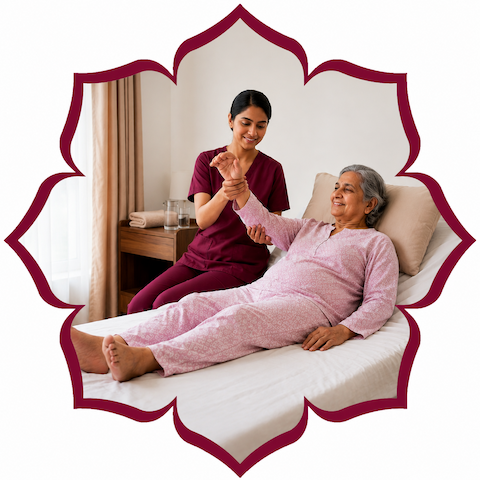
Passive ROM exercises were provided to the right upper and lower limbs. Passive and active-assisted ROM exercises are commonly incorporated into rehabilitation for patients with significant motor impairment when appropriate.
Stage 2: Improving Bed Mobility and Muscle Activation
The neuro physiotherapy exercise regime began slowly introducing movement patterns which could be done without moving the patient out of his bed.
The bed mobility exercises included:
- Supine to side lying
- Side lying to high sitting
Movement of the lower limbs involved straight leg raises from a supine position using the knee immobilizer. Abduction and adduction exercises were performed in supine lying with assistance, along with pelvic bridging.
Electrical stimulation was also provided to the right upper and lower limbs as part of the documented rehabilitation program.
This step was not intended to just work the muscles separately. It was intended to get the patient involved in moving around and help them move towards better positions.
Rehabilitation Progress
Reassessment on July 30, 2026
After 10 days from first evaluation, there were some improvements observed in muscle power of the patient.
| Muscle Group | Initial Assessment | July 30 |
|---|---|---|
| Right Upper Limb | 0/5 | 1/5 |
| Right Lower Limb | 0/5 | 1/5 |
| Left Upper Limb | 5/5 | 5/5 |
| Left Lower Limb | 5/5 | 5/5 |
The right upper and lower limbs had progressed from 0/5 to 1/5.
ROM assessment also showed that passive movement could be performed in the right upper limb, including shoulder flexion, elbow flexion, shoulder extension, abduction and adduction. Active ROM remained limited by muscle weakness.
At this stage, gait was described as impaired, and rehabilitation began moving beyond bed-based activities.
Functional Milestones
An important part of the July 30 reassessment was the achievement of several functional goals.
The patient had attained:
- Bed mobility
- Assisted high sitting
- Assisted sit-to-stand
This constituted a definite improvement from the state of bedriddenness that he was in at first.
The rehabilitation program was expanded to include standing with assistance and gait training.
Stage 3: Progressing Toward Standing and Functional Mobility
On August 18, 2026, another milestone was accomplished.
| Muscle Group | Initial Assessment | July 30 | August 18 |
|---|---|---|---|
| Right Upper Limb | 0/5 | 1/5 | 2/5 |
| Right Lower Limb | 0/5 | 1/5 | 2/5 |
| Left Upper Limb | 5/5 | 5/5 | 5/5 |
| Left Lower Limb | 5/5 | 5/5 | 5/5 |
The patient's right upper- and lower-limb muscle power had improved to 2/5.
The ROM findings also documented mild improvement in some right upper-limb movements. Elbow flexion showed mild improvement, while shoulder abduction and adduction also showed mild improvement. Passive ROM of the lower limb remained within normal limits.
The patient had already started achieving sitting balance with the help of support. Standing was achieved by means of assistance provided by two persons.
Progression of Exercises
With improving functional abilities, there came an increased activity in the neurological rehabilitation regimen.
Interventions documented include:
- Passive ROM of the upper and lower limbs
- Stretching
- Assisted SLR with knee immobilization
- Assisted abduction/adduction in supine
- Sit-to-stand training
- Static standing
- Cycling
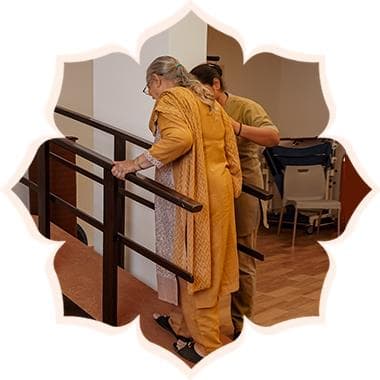
- Walking with parallel bars
- Electrical stimulation of right upper and lower limbs
- Joint vibration
This gradual transition from bed mobility to activities related to sitting, standing, and walking represents a task-oriented rehabilitation regimen. Rehabilitation guidelines support repetitive, progressively adapted and goal-oriented practice for mobility tasks such as sit-to-stand and walking.
Rehabilitation Approach
Individualized Neurological Rehabilitation
The rehabilitation plan was adjusted according to the patient's changing abilities.
At the initial assessment, the patient had no measurable muscle power in the right upper and lower limbs. Therefore, the program began with passive ROM and assisted movements.
As muscle power improved to 1/5 and then 2/5, the program incorporated increasingly functional activities, including sitting, standing, cycling and parallel-bar walking.
This type of progression is important because neuro rehabilitation is not limited to improving isolated muscle strength. Functional rehabilitation also considers how a patient can use improved movement for activities such as transfers, sitting, standing and walking.
Bed Mobility Training
Bed mobility was one of the first functional objectives.
The patient practiced:
Supine → Side lying → Supported sitting
This progression helped move the patient from a completely bed-dependent position toward greater participation in positional changes.
Bed mobility was also one of the documented goals achieved during the rehabilitation period.
Sitting and Standing Training
As the patient's strength improved, supported sitting became possible.
By August 18, the patient could maintain sitting balance with support. Two-person assistance was possible for standing position.
Sit to stand exercises were introduced for functional weight bearing and transitions.
Written reassessment notes indicate sitting to standing with 4 person assist was finally achieved.
Gait and Functional Mobility Training
The gait training at the neurological rehabilitation centre began following the patient's adequate progression during bed mobility and supported standing.
The tasks intended for completion were:
- Static standing balance
- Cycling
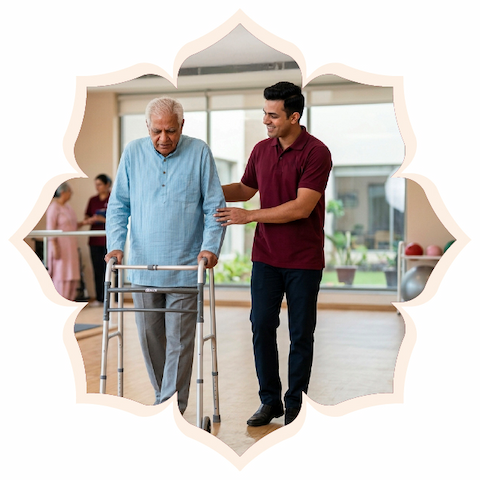
- Parallel bar walking
- Walker-assisted walking
At this point, the aim was to transition from supported standing into functional ambulation. According to well-established guidelines for rehabilitation, repetition of task-oriented mobility is encouraged in gait-impaired individuals, with the amount of assistance tailored to their capabilities.
Rehabilitation Goals
Short-Term Goals
The initial goals were to:
- Improve muscle power
- Prevent deformity
- Maintain and improve ROM
- Improve bed mobility
- Encourage active participation
- Prepare the patient for sitting and standing activities
Long-Term Goals
The long-term goals focused on functional independence, including:
- Improving overall movement
- Progressing toward independent sitting
- Improving standing ability
- Improving activities of daily living
- Reducing dependence where possible
- Progressing toward functional ambulation
ADL-focused rehabilitation is an important part of neurological recovery because mobility improvements need to translate into practical daily activities. Stroke rehabilitation guidelines specifically recommend individualized ADL training based on patient needs and functional goals.
Progress and Reassessment
The documented assessments show a gradual improvement in right-sided muscle power and functional mobility.
| Parameter | July 20, 2026 | July 30, 2026 | August 18, 2026 |
|---|---|---|---|
| Right Upper-Limb Power | 0/5 | 1/5 | 2/5 |
| Right Lower-Limb Power | 0/5 | 1/5 | 2/5 |
| Bed Mobility | Dependent/bedridden | Achieved | Achieved |
| Sitting | Not documented as functional | Assisted high sitting | Sitting with support |
| Sit-to-Stand | Not possible initially | Assisted | With 4-person support |
| Standing Control | Not documented | Training initiated | With 2-person support |
| Gait | Not applicable | Impaired | Parallel-bar/walking training planned |
The progression is particularly notable because the patient's right-sided muscle power improved from 0/5 to 2/5 over the documented assessment period.
Functional progress accompanied this improvement. The patient moved from being bedridden to achieving bed mobility, assisted high sitting and sit-to-stand. By August 18, he could maintain sitting balance with support and stand with two-person assistance.
These improvements should be understood as the patient's documented progress during the stated rehabilitation period rather than as evidence of complete recovery or independence.
Key Takeaway
This case is an example of how neurological rehabilitation can be achieved by making progressive functional gains.
The patient presented with significant right side weakness with muscle power of 0/5 in the right upper and lower extremities. The patient could not take part in gait-related activities because he was bed-bound.
The rehabilitation journey then progressed through several stages:
- Initial phase: Passive ROM and positioning
- Bed mobility phase: Supine-to-side lying and supported sitting
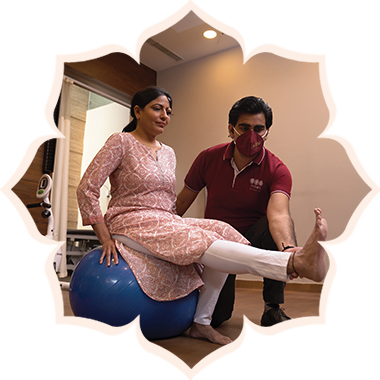
- Strengthening phase: Assisted SLR, abduction, adduction and pelvic bridging
- Functional phase: Sit-to-stand and supported standing
- Mobility phase: Cycling, parallel-bar walking and planned walker-supported walking
The patient's documented muscle power improved progressively from 0/5 to 1/5 and then 2/5 on the affected side.
The case also demonstrates why rehabilitation goals need to be progressive. A patient who cannot move a limb at the beginning may first need to work toward assisted positional changes before progressing to sitting, standing and walking.
For individuals undergoing hemiplegia rehabilitation or recovering from significant neurological weakness, rehabilitation may therefore involve a series of carefully graded functional goals rather than one immediate objective such as walking independently.
Conclusion
This is a case where the need for a proper neurological rehabilitation program is evident to aid in the recovery process after neurological surgery and significant weakness on the right side.
The patient started with a rehabilitation program when bedridden and having no muscle power (0/5) in the right upper and lower limbs. The recorded muscle power increased to 1/5 and then 2/5 in the course of the rehabilitation period. This increase in muscle power accompanied the progress of the patient from simple bed rehabilitation exercises to assisted high sitting, bed mobility, sit to stand and sitting and standing with support.
This progressive rehabilitation program consisted of passive ROM and assisted exercises, strengthening, sitting and standing, cycling, balance and gait training.
Though the patient did not achieve independence in mobility at the end of the last recorded assessment, the recorded changes were important for the rehabilitation process.
For those who have significant movement impairment, a structured neuro rehabilitation centre will help with the multileveled assessment and treatment needed. In the same way, for those patients who require hemiplegia rehabilitation, neurological rehabilitation after surgery, and neurological rehabilitation after having any disease related to the brain, a customized rehabilitation center will help.
What is most important about this case study is the fact that the process of neurological recovery can be seen as a process of accomplishing milestones – moving in bed, sitting down, standing up, and so on.