Introduction
Recovery after a severe traumatic brain injury can be a long and challenging process. It is particularly when complications develop after the initial injury. Post-traumatic hydrocephalus, prolonged immobility, lesser sensorium, muscle wasting, and associated injuries can all affect the ability of a patient to regain that functional independence.
This case shows the rehabilitation journey of a 37-year-old male living in Mahadevapura, Bengaluru. He is suffering from post-traumatic hydrocephalus and a right post-trepanation defect following a very severe head injury. He also had a left radius fracture that was managed conservatively.
When the patient arrived, he was bedridden, emaciated and had reduced sensorium. He also had pressure sores over the occipital and sacral regions. His situation required very careful medical management along with a structured as well as a progressive neuro-physiotherapy rehabilitation program.
The focus of the neuro rehabilitation after brain injury was to prevent complications, maintain joint mobility, gradually improve tolerance to upright positioning and progress toward functional movement.
Understanding the Case
Severe Brain Injury and Post-Traumatic Hydrocephalus
The patient sustained a head injury in April 2026. Imaging revealed a right subdural injury with diffuse axonal injury. He had a right FTP decompressive craniectomy and tracheostomy done at another place.
In addition, there was a left radius fracture which was managed conservatively.
Since there was no improvement in the sensorium, he was found to have developed post-traumatic hydrocephalus and then transferred to KIMS Hospitals for treatment.
When he was admitted on July 3, 2026, he was totally bed ridden and depended upon for movement and activities of daily living. He presented with generalized muscle wasting, marked lower-limb wasting, poor arousal and restricted range of motion. The left upper limb was additionally affected by the fracture and associated deformity.
The starting physiotherapy assessment showed global muscle power of 0/5. This indicated profound weakness and the need for a highly supported rehabilitation approach.
Condition on Admission
When the patient presented for further treatment, he was in a severely deconditioned state.
The initial clinical picture included:
- Reduced sensorium and poor arousal
- Bedridden status with dependence for mobility
- Generalized muscle wasting and emaciation
- Marked lower-limb wasting
- Restricted range of motion associated with prolonged immobility
- Left upper-limb limitations related to the radius fracture
- Pressure sores over the occipital and sacral regions
- Significant risk of contractures and further physical deconditioning
- Complete dependence for bed mobility, transfers and activities of daily living
- Muscle power was documented as 0/5 globally at the initial physiotherapy assessment.
At this stage, physiotherapy after brain injury was not simply about helping the patient walk. The immediate priority was to protect his physical condition while gradually preparing his body for more active rehabilitation.
Neurosurgical Management
The patient underwent a series of important medical and surgical interventions during his admission:
- 06 July 2026: Wound debridement and primary closure of the occipital pressure sore
- 15 July 2026: Left parietal medium-pressure ventriculo-peritoneal (VP) shunt placement
- 15 July 2026: Right FTP cranioplasty using a customised titanium implant
- Ongoing nutritional support, wound care, chest care and management of the fracture
VP shunting is an established treatment approach for selected patients with post-traumatic hydrocephalus. Evidence from rehabilitation populations also supports the importance of coordinated neurosurgical and rehabilitation management in patients with severe acquired brain injury and hydrocephalus.
Stages of Recovery
The patient's recovery was approached progressively. Rather than immediately attempting complex movements, the rehabilitation team moved through stages based on his tolerance and functional ability.
Stage 1: Prevention of Complications During the Bedridden Phase
During the initial bedridden phase, the patient required intensive supportive neurorehabilitation physiotherapy. The primary objective was to prevent secondary complications, preserve physiological function, and prepare the patient for progressive mobilization.
Key interventions included:
- Chest physiotherapy to maintain airway clearance and optimize respiratory function.
- Regular positioning and postural management, approximately every two hours, to prevent pressure injuries and maintain optimal alignment.
- Passive and active-assisted range-of-motion exercises to maintain joint mobility and minimize stiffness.
- DVT prophylaxis exercises, including appropriate lower-limb movements and early mobility as tolerated.
- Pressure area care and regular skin monitoring to reduce the risk of pressure injuries.
- Splinting and positioning aids, where required, to prevent abnormal postures and contracture development.
- Maintenance of available joint range and muscle length through regular therapeutic exercises.
- Management of abnormal muscle tone/spasticity, where present, through positioning, stretching, and appropriate therapeutic techniques.
- Facilitation of sensory and motor stimulation to promote early neurological recovery.
- Bed mobility training, including rolling, bridging, and repositioning, as the patient's condition permitted.
- Progressive sitting tolerance and postural control training to prepare the patient for subsequent mobilization.
- Caregiver education regarding positioning, pressure care, safe handling, and home-based exercises.
- Continuous monitoring of vital signs, fatigue, neurological status, and exercise tolerance during rehabilitation.
The overall goal of this stage was to prevent secondary complications, preserve functional capacity, and establish a safe foundation for progressive rehabilitation and mobilization.
Stage 2: Gradual Upright Positioning and Tilt-Table Training
Once the patient was medically stable, the rehabilitation focus progressed toward gradual verticalization and improving tolerance to the upright position. The objective was to safely prepare the patient for sitting, weight-bearing, and subsequent functional mobility while minimizing the complications associated with prolonged bed rest.
Key interventions and goals included:
- Gradual upright positioning using a tilt table to improve tolerance to vertical posture.
- Progressive weight-bearing through the lower limbs to provide appropriate mechanical and sensory input.
- Prolonged stretching of the lower-limb musculature to maintain muscle length and reduce the risk of contractures.
- Improvement of peripheral circulation through positioning, limb movements, and progressive weight-bearing.
- Monitoring and management of orthostatic intolerance, including changes in blood pressure, heart rate, oxygen saturation, and symptoms during tilting.
- Improvement of postural alignment and trunk control while progressing toward an upright position.
- Reduction of the physical consequences of prolonged immobilization, including stiffness, deconditioning, reduced cardiovascular tolerance, and loss of functional capacity.
- Sensory and proprioceptive stimulation through controlled weight-bearing and changes in body position.
- Preparation for functional activities, including supported sitting, transfers, standing, and eventual mobility.
- Caregiver education and involvement to ensure safe positioning and handling during the rehabilitation process.
With gradual progression, the patient was able to tolerate 60–80° of tilt-table elevation. However, the patient continued to require full support to maintain the upright position, indicating significant residual deficits in postural control and functional independence.
Despite the continued need for assistance, achieving this level of upright tolerance represented a significant milestone in the rehabilitation journey, marking the transition from complete bed dependency toward active participation in progressive neurorehabilitation and functional recovery.
Stage 3: Sitting Endurance and Active-Assisted Cycling
As the patient's tolerance increased, the rehabilitation protocol continued by going past the phases of positioning and passive exercises.
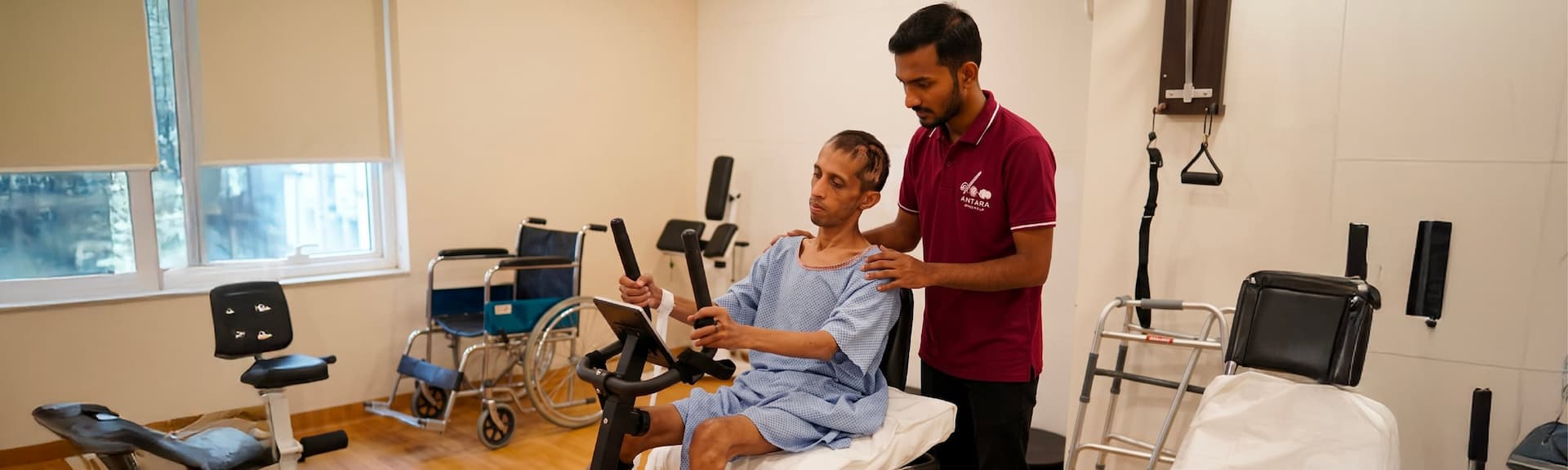
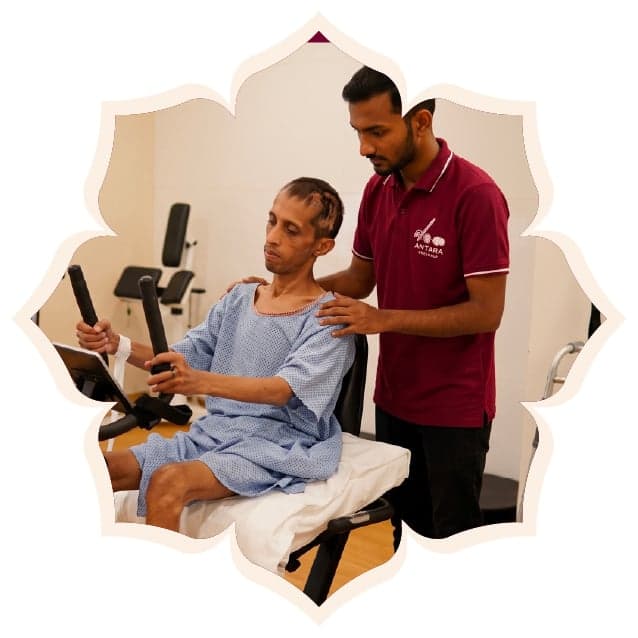
He started the cycle ergometry for the lower limb in sitting position with back support. While a physical therapist stood behind him, she provided him with truncal support and facilitation. Meanwhile, minimal assistance was used to initiate the process of pedaling. His feet were fastened to the pedals.
In this phase, repetitive lower limb movement was included in an active task.
The objectives involved:
- Increasing the active range of movement of the lower limb
- Increasing endurance
- Repetitive movement
- Improving circulation
- Increasing sitting tolerance
- Active involvement in rehabilitation
- Proceeding towards task-oriented movement
Cycling in a seated position reflected substantial progress of the patient compared to his inability to perform active exercises.
Stage 4: Assisted Over-Ground Ambulation
The next big step in the treatment process was assisted gait training.
The patient advanced to ambulation with over-ground assistance by two people. Two therapists were helping the patient with axillary support, providing verbal stimulation encouraging an erect position.
Goals included:
- Lower limb weight bearing
- Activation of trunk muscles
- Initiation of gait
- Postural control
- Functional task repetition
- Mobility improvement
The patient had not walked independently at that stage. But the fact that he advanced from non-ambulatory status to assisted gait is considered a big step in the treatment process.
This progression illustrates an important principle of traumatic brain injury rehabilitation: functional recovery may involve several carefully graded steps rather than a sudden return to normal movement.
Rehabilitation Approach
Individualized Neuro Physiotherapy
The rehabilitation program was adapted to the patient's neurological status, physical weakness, prolonged immobility and associated fracture.
The approach progressed from passive and preventive interventions to active-assisted exercise, upright tolerance training and assisted ambulation.
This phased approach was particularly important because the patient began rehabilitation in a severely deconditioned state. Each activity was introduced according to his functional tolerance rather than following a fixed progression.
Progression From Passive to Active Movement
Initially, the patient could not actively participate in movement because muscle power was documented as 0/5.
The rehabilitation approach therefore began with passive movements and positioning. With increasing muscle activity, the treatment became progressively more active-assisted movements and functional tasks.
The above progression can be described as follows:
Bed-ridden → Passive ROM → Tilt table exercise → Supported sitting → Active-assisted cycle ergometry → Assisted standing → Assisted walking
The above progression better describes the patient’s rehabilitation process than just a muscle strength test.
Functional Mobility Training
The ultimate focus of a structured Neuro rehabilitation was not muscle strength alone. The patient needed to regain the ability to participate in practical movements.
Therefore, treatment progressed toward:
- Bed mobility
- Upright tolerance
- Sitting
- Standing
- Weight-bearing
- Cycling
- Assisted walking
- Activities of daily living
By the final documented assessment, the patient had progressed to maximum-to-moderate assistance for ADLs, compared with complete dependence at the beginning of rehabilitation.
Rehabilitation Goals
The rehabilitation team established both short-term and long-term goals.
Short-Term Goals
The immediate goals were to:
- Prevent secondary complications associated with immobility
- Protect skin integrity and support pressure care
- Maintain joint range of motion
- Reduce the risk of contractures
- Support circulation
- Improve chest function through appropriate physiotherapy
- Improve arousal and tolerance to upright positioning
- Begin safe early mobilization
Long-Term Goals
As the patient's condition improved, the focus shifted toward:
- Increasing muscle power
- Improving truncal control
- Developing sitting balance
- Progressing toward standing
- Initiating assisted ambulation
- Improving functional endurance
- Increasing participation in ADLs
- Reducing dependence on caregivers where possible
The documented muscle power improved from 0/5 initially to approximately 3–4/5, except in the fracture-affected hand.
Progress and Reassessment
The patient's functional status showed progressive improvement during rehabilitation.
| Parameter | Initial Status | Final Documented Status |
|---|---|---|
| Muscle Power | 0/5 | 3–4/5, except fracture-side hand |
| Standing | Unable | Tilt table 60–80° with maximum assistance |
| Sitting Balance | Poor | Supported sitting during cycling |
| Ambulation | Not possible | Walking with two-person support |
| Endurance | Not possible | Active-assisted cycling |
| ADLs | Totally dependent | Maximum to moderate assistance |
The most notable change was the improvement in documented muscle power from 0/5 to 3–4/5 in most areas. The patient also progressed from complete bed dependence to supported upright activity, cycling and assisted over-ground walking.
The fracture-side hand remained weak due to the associated deformity.
Key Takeaway
This is an example of how neuro rehabilitation after brain injury may consist of several related stages.
Recovery of this patient was not based on any single activity or procedure but rather included a number of different treatments like neuro surgery, medicine, prevention of complications and physiotherapy.
Several aspects of the rehabilitation journey stand out:
- Early prevention matters: Positioning, pressure management, ROM exercises, chest physiotherapy were vital at the time when the patient could only stay in bed.
- Progression must be gradual: Tilt table training was used as a transitional approach to positioning.
- Functional activities encourage participation: Seated cycling introduced repetitive active movement along with the endurance work.
- Walking is a progression: The patient advanced to over-ground walking only after developing greater tolerance and control.
- Recovery can occur in stages: Improvement from 0/5 muscle power to 3–4/5 was accompanied by changes in sitting, standing, cycling and walking ability.
- Associated injuries matter: The left radius fracture continued to affect hand function and remained a limiting factor.
Evidence from patients with severe acquired brain injury and hydrocephalus also indicates that functional and cognitive improvements can occur following appropriate surgical and rehabilitation management, although individual outcomes vary considerably.
Conclusion
The above case underscores the need for a proper and well-planned physiotherapy rehabilitation program after the occurrence of traumatic brain injury and post-traumatic hydrocephalus.
The severe brain injury recovery process moved from being preventive bedside treatment and passive exercise through graded tilt-table mobility, sitting in supported position, active cycling with assistance, and two-person ambulation.
The recorded gain in muscle strength and functional mobility indicates the gains made within the period of rehabilitation. The case also reveals how rehabilitation could be customized depending on the changes that are taking place in the patient.
Physiotherapy still holds the key for more gains to be made.
This case highlights the importance of a structured and individualized TBI rehabilitation approach to physiotherapy after traumatic brain injury. The patient entered rehabilitation in a severely deconditioned condition, with reduced sensorium, generalized weakness, pressure sores and complete dependence for mobility and daily activities.